
Protecting Remote Workers with Smart, Responsive Safety Solutions
Real-time alerts and accurate indoor/outdoor tracking for high-risk and isolated work environments
In today’s distributed workforce, lone and remote workers operate without direct supervision—servicing equipment in the field, conducting home visits, or monitoring facilities late at night. These individuals face the same risks as any employee, but without the safety net of immediate support.
What if they could trigger an alert and be located within seconds—whether they’re deep inside a facility, alone on a wind turbine, or miles out at sea on a maritime vessel?
With modern safety technology like Traxmate’s, that level of protection is now a reality.

Remote safety made visible, actionable, and reliable.
The Need for Remote Worker Safety Solutions
In 2024, approximately 53 million people across Europe, the UK, and North America—15% of the workforce—regularly worked alone (Hill et al. 2024). The absence of real-time backup doesn’t just increase vulnerability to accidents; it makes timely intervention harder, risk assessment more complex, and outcomes potentially more severe.
Although Europe, the UK, and the United States do not have standalone lone worker laws, general occupational safety and health (OSH) regulations in each region apply to workers in isolated settings.
In Europe, this responsibility is established under the EU OSH Framework Directive 89/391/EEC; in the UK, under the Health and Safety at Work Act 1974 and the Management of Health and Safety at Work Regulations 1999; and in the U.S., through OSHA’s General Duty Clause and specific standards such as OSHA 1915.84 for shipyard lone working (European Agency for Safety and Health at Work, 2021; OSHA, 2011). Across all jurisdictions, employers are expected—and legally obligated—to identify, assess, and mitigate the risks associated with lone and remote work.
The safety challenges facing remote and lone workers are not hypothetical—they are well-documented, rising, and increasingly urgent. According to Berg Insight, by the end of 2024, 2.3 million lone workers across Europe, North America, and Australasia were using connected safety solutions, such as panic alarms, GPS tracking, and man-down detection systems.
That number is projected to grow steadily, with Europe alone expected to increase from 1.2 million to nearly 1.7 million users by 2029, at a CAGR of 7.1% (Berg Insight, 2025).
What’s driving this growth? Several converging factors:
- A rise in regulatory scrutiny and updated guidance
- Increased insurance costs for high-risk roles
- Greater organizational awareness of lone worker vulnerabilities
- A growing recognition of the efficiency and accountability enabled by digital safety platforms
Critically, nearly 70% of organizations report having experienced at least one safety incident involving a lone worker in the past three years, with one in five described as severe (National Safety Council, 2024). These numbers reflect not only the scope of the issue, but also the need for more proactive, technology-driven safety measures that ensure workers can be located and assisted the moment something goes wrong.
The Cost of Failing on Safety
The consequences of inadequate protection for remote and lone workers can be devastating, both in terms of human and financial impact. A sobering example comes from the UK, where a lone employee at South West Water drowned after falling into a treatment tank while working alone. Although safety systems were in place, no one responded in time. The company was fined £1.8 million for failing to act on known safety hazards (WorkNest, 2023).
These incidents don’t just result in legal penalties—they lead to reputational damage, operational disruption, and lasting harm to workforce morale. In contrast, organizations that prioritize safety not only comply with regulations—they build trust, improve retention, and reduce costly downtime.
As the International Labour Organization (2025) notes, safety is not only a legal requirement—it’s a strategic investment. In environments where risk is high and help may be far away, remote worker safety solutions are no longer a nice-to-have—they’re a business-critical necessity.
How It Works:
Traxmate for Remote Worker Safety Solutions
Traxmate acts as the centralized platform for safeguarding remote and lone workers across industrial sites, offshore operations, and high-risk field environments. The platform connects to a range of wearable safety devices—such as panic buttons, smart tags, or ruggedized trackers—enabling real-time visibility and rapid response when every second matters.
Traxmate is also designed to accommodate a wide range of positioning needs, for example:
- For high-precision use cases, it integrates seamlessly with our partner Combain’s advanced indoor positioning—ideal for vessels, tunnels, or complex industrial facilities. Using Combain’s indoor positioning in another system resulted in an 83% reduction in time to full employee accountability – read more about it here.
- For low-power or large-scale deployments, it supports Cell ID-based positioning, offering global reach with minimal energy consumption.
Whether your priority is accuracy, battery life, or global scalability, Traxmate lets you match the proper tracking method to each worker and environment.
When a panic button is pressed, or a sensor detects a fall or loss of motion, Traxmate initiates an immediate, automated workflow:
- An alert is raised on a live, map-based dashboard showing the worker’s exact location—even indoors or in GPS-restricted environments
- Instant notifications are sent to supervisors, safety teams, or control rooms via mobile, desktop, or integrated systems
- Worker status is monitored in real time, including movement, fall detection, and zone-based presence (e.g., inside a hazard zone)
- All events are logged with timestamps and location history to support audits, investigations, and compliance
With hardware-agnostic integration and flexible deployment, Traxmate scales from single-site installations to global enterprise safety networks.
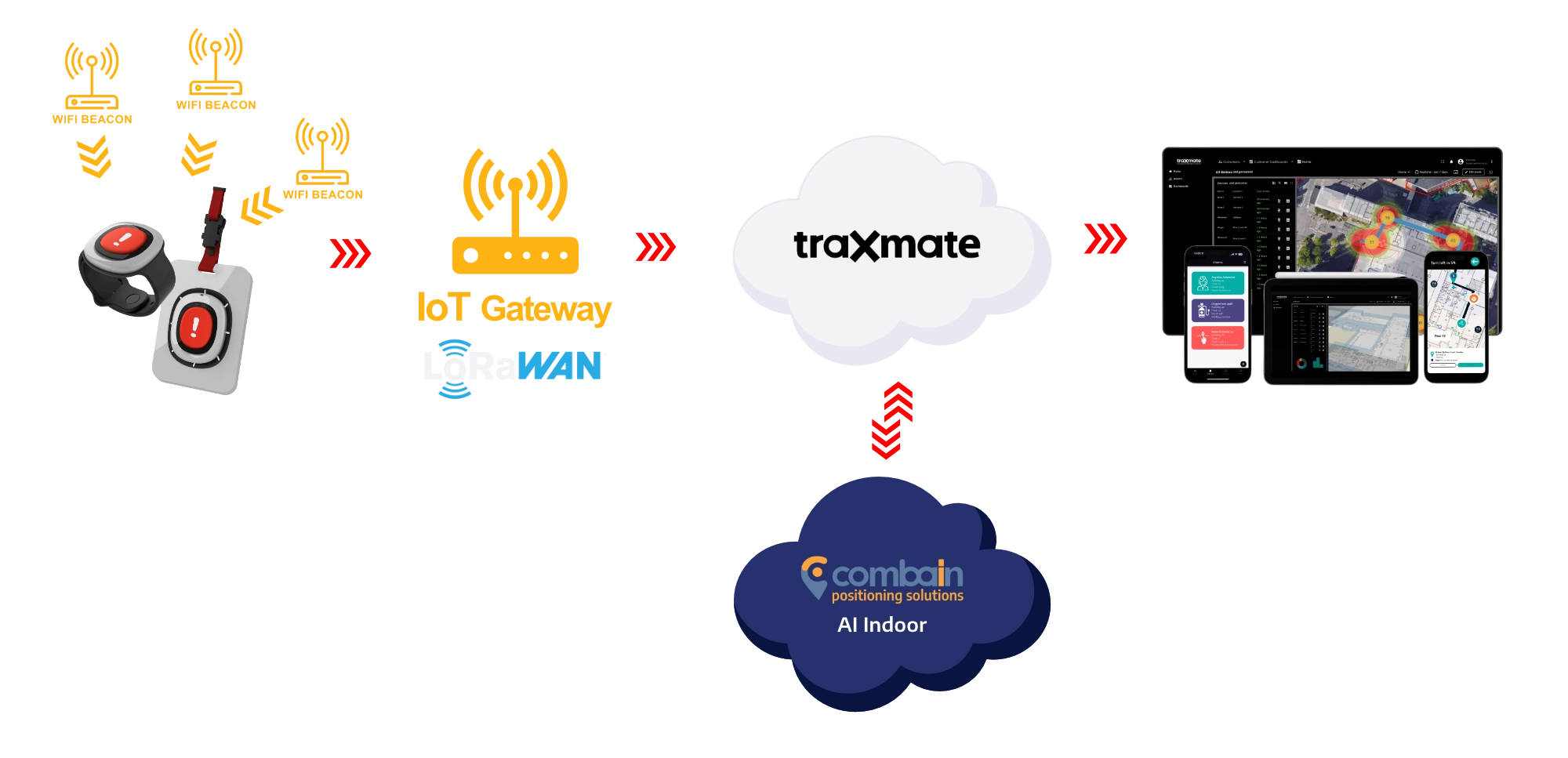
With a single button press or automated trigger to a sensor, an alert is transmitted via the IoT gateway to Traxmate, instantly triggering real-time tracking using technology based on your specific needs, which is made visible on the live platform.
Real-World Scenario:
Offshore Incident on a Maritime Vessel
A maintenance technician is working alone on the side of a maritime vessel, conducting a routine inspection. Suddenly, the worker slips—harnessed, but injured—and is unable to call for help. His smart safety device detects the fall and automatically triggers an alert.
Within seconds, Traxmate raises the alarm in the ship’s existing command center, displaying the technician’s exact location on the vessel using accurate indoor and outdoor positioning. Crew members are notified instantly and dispatched to assist, reaching the technician within minutes—well before a delayed or manual check-in would have raised concern.
This scenario highlights how Traxmate’s real-time tracking and automated detection, utilizing Combain’s accurate indoor positioning, can reduce response times from over 30 minutes to under 10. Integrating Combain indoor positioning with another platform resulted in an 83% reduction in time to full employee accountability. Read more about it here. Real-time tracking is revolutionizing the management of remote safety, even in the most complex environments.

Why Traxmate for Remote Worker Safety?
Traxmate is trusted in safety-critical environments where accurate location data and instant alerts can make the difference between incident and intervention. It’s designed to protect people—not just track them—with a flexible, scalable platform that integrates easily into your operations.
Key Benefits
Smart Alert Handling & Automation
Triggered manually or via fall/inactivity detection—ensuring help is dispatched even if the worker can’t call for it.
Live Location & Movement Tracking
View personnel in real time across complex or multi-level worksites, including GPS-denied areas.
Indoor/Outdoor Hybrid Positioning
Combines BLE, WiFi, GNSS, Cell ID, and 5G positioning for maximum coverage in tunnels, vessels, rooftops, or remote terrain.
Hardware-Agnostic Integration
Compatible with panic button providers, rugged wearables, smart badges, and custom devices.
Seamless Notifications
Alerts sent via app, email, SMS, or to integrated platforms (e.g. command center dashboards).
Compliance & Audit Support
Helps meet OSH obligations in Europe, the UK, and the U.S., with full event logging and data protection built-in.
The Business Case for Remote Worker Safety Solutions with Traxmate
Investing in remote worker safety isn’t just about compliance—it’s a strategic business decision.
With 53 million people regularly working alone across Europe, the UK, and North America, and nearly 70% of organizations having reported safety incidents involving lone workers in the past three years, the need for reliable, real-time safety systems is clear. Organizations that fail to act face severe consequences, ranging from operational disruptions to legal penalties, as seen in the £1.8 million fine issued in the South West Water case.
Traxmate for Remote Worker Safety Solutions helps mitigate these risks through:
- Real-time alerts and automated incident detection
- Accurate indoor/outdoor positioning—even in GPS-denied areas
- Seamless integration with your existing safety ecosystem
The result? Reduced response times, improved accountability, and had a measurable impact on worker safety, trust, and business continuity.
Next Steps
Ready to Protect Your Remote Workforce?
Whether your team works offshore, in industrial zones, or across remote service locations, Traxmate gives you the visibility, responsiveness, and flexibility needed to keep them safe.
Let’s build a safer, smarter response system together.
Contact us today to schedule a demo or consultation.
Key Takeaways
Who is affected and how large is the lone-worker problem?
About 53 million people in Europe, the UK, and North America regularly work alone, roughly 15 percent of the workforce.
What adoption trend supports connected safety?
- Lone workers using connected safety solutions reached 2.3 million in 2024 across Europe, North America, and Australasia.
- Europe is projected to grow from 1.2 million to nearly 1.7 million by 2029, a 7.1 percent CAGR.
What legal and compliance context applies?
OSHA has applicable rules, for example, 29 CFR 1915.84 on working alone, and broader duty-of-care obligations apply. Guidance from authorities emphasizes risk assessment and timely response for isolated workers.
What outcomes can accurate indoor positioning deliver in emergencies?
Time to full employee accountability can drop by 83 percent when accurate indoor positioning is integrated, with practical scenarios moving from more than 30 minutes to under 10 minutes.
How does Traxmate protect remote and lone workers in practice?
- Devices and wearables trigger manual or automatic alerts.
- Traxmate shows the worker’s live location indoors and outdoors,
- notifies responders instantly, tracks movement and zone presence, and…
- logs every event for audits and investigations.
What positioning methods are available for different environments?
Hybrid positioning across BLE, WiFi, GNSS, Cell ID, and 5G. You match accuracy, battery life, and coverage to each role and site, from tunnels and vessels to remote terrain.
What business risks exist for failing to protect lone workers?
- Incidents can result in legal penalties, reputational damage, and disruption.
- A recent UK case resulted in a 1.8 million pound fine after a lone-worker fatality.
What is the operational value for safety teams?
Faster detection and response, clearer accountability, support for OSH compliance, and a complete audit trail, all in a hardware-agnostic platform that scales from single sites to global deployments.
Monitor the real-time location of workers across job sites, offshore platforms, or isolated facilities to enable quicker, more informed emergency response.
Workers can raise alarms with one press—or automatically via fall detection or inactivity sensors—ensuring rapid support in critical moments.
Works with smartphones, wearable buttons, smart badges, or rugged safety devices—easily fitting into your existing operations and gear.
Combines indoor and outdoor tracking methods to maintain location accuracy in tunnels, stairwells, rooftops, and other GPS-challenged zones.
A Remote Worker Safety Solution is a real-time system that helps protect employees working alone or in high-risk, isolated environments—such as utility sites, offshore vessels, or remote field locations.
Using tools like panic buttons, location tracking, and sensor-based alerts, the system enables workers to quickly signal for help during emergencies like accidents, medical events, or safety threats. It also provides responders with the worker’s precise location, allowing for faster, more coordinated assistance.
Remote Worker Safety Solutions are used across industries to reduce response times, improve compliance, and protect personnel when it matters most.